

Introduction
Understanding the critical difference between cash flow vs profit is the single most important financial lesson an entrepreneur can learn. I learned this lesson in the most painful way possible. Four years ago, I ran a digital agency that looked wildly successful on paper. We had just closed a $50,000 contract. My Profit and Loss (P&L) statement showed a healthy bottom line. I felt rich. I hired a new designer and upgraded our software subscriptions.
Two weeks later, I tried to run payroll, and the transaction failed. Insufficient funds. I stared at my screen in horror. How could we be “profitable” but completely broke? The answer was simple: The client hadn’t paid yet. I had booked the revenue (Profit), but I hadn’t collected the money (Cash Flow).
That weekend, I had to borrow money from my personal savings just to pay my team. It was humiliating, but it taught me the golden rule of business: Revenue is vanity, profit is sanity, but cash is king.
In this comprehensive 1200-word deep dive, I will deconstruct the accounting principles that confuse most founders, explain the “Cash Conversion Cycle,” and show you exactly how to master cash flow vs profit so you never have to panic on payday again.
1. The Illusion of Profit: Accrual vs. Cash Accounting
To understand why you can be profitable and broke simultaneously, you have to understand accounting methods. Most businesses use Accrual Accounting. This means you record income when you send the invoice, not when you get the cash.
-
Scenario: You sell a website design for $10,000 on January 1st. You send the invoice with “Net 60” terms (payment due in 60 days).
-
The Profit View: On January 1st, your accountant says you made $10,000 profit. You pay taxes on this “profit.”
-
The Cash View: On January 1st, you have $0 in the bank. On February 1st, you still have $0. You cannot pay rent with an invoice.
This disconnect is the silent killer of startups. According to a study by U.S. Bank, 82% of small business failures are due to poor cash flow management, not a lack of profit. Mastering the timing difference in cash flow vs profit is survival.

2. What is Cash Flow? (The Oxygen of Business)
If profit is nutrition (it helps you grow over time), cash flow is oxygen (you need it every second to survive). Cash Flow is simply the movement of money in and out of your business bank account.
-
Positive Cash Flow: More money is coming in than going out right now.
-
Negative Cash Flow: You are spending money faster than you are collecting it.
A business can survive for years without profit (look at Amazon or Uber in their early days) as long as they have positive cash flow from investors or loans. But a profitable business will die in weeks without cash. You need to track your Burn Rate—how much cash you consume each month. If your burn rate exceeds your cash reserves before the next payment arrives, you hit the “Cash Flow Crunch.”
3. The Cash Conversion Cycle (CCC): The Speed of Money
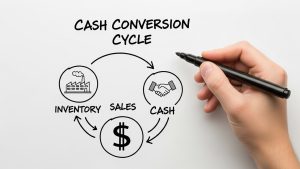
This is a metric used by top CFOs, but every small business owner should know it. The Cash Conversion Cycle measures how many days it takes for a dollar you spend (on rent, inventory, or wages) to come back to your pocket as a dollar collected from a customer.
The Formula: Days Inventory Outstanding + Days Sales Outstanding – Days Payable Outstanding = CCC
In plain English:
-
How long does your product sit on the shelf?
-
How long does it take customers to pay you?
-
How long do you wait to pay your own bills?
The Goal: You want a negative CCC. This means you get paid by your customers before you have to pay your suppliers. Amazon does this brilliantly. You pay Amazon today; they pay the book publisher 60 days later. They hold your cash for two months, using it to grow. That is the ultimate mastery of cash flow vs profit.
4. The “Valley of Death”: Growth Sucks Cash
Here is a paradox: Growing too fast can kill you. Imagine you suddenly get an order for 10,000 units of your product. Great news, right? Huge profit! But wait. You have to pay for the materials now. You have to pay overtime wages now. You have to pay for shipping now. But the retailer won’t pay you for 90 days.
You have just created a massive cash hole. This gap between spending for growth and receiving the rewards is called the “Valley of Death.” Many profitable businesses die here because they run out of cash trying to fulfill orders. To navigate cash flow vs profit during growth, you often need a line of credit or factoring services to bridge the gap.
5. Strategies to Fix Your Cash Flow Immediately
You don’t need a finance degree to fix this. You need better operations.
-
1. Invoice Immediately: Don’t wait until the end of the month. Send the invoice the second the work is done.
-
2. Shorten Payment Terms: Stop offering “Net 30” or “Net 60” by default. Ask for “Due on Receipt” or “Net 15.”
-
3. Ask for Deposits: Never start a service project without a 50% upfront deposit. This covers your costs.
-
4. Delay Payables: If a vendor gives you 30 days to pay, take 29 days. Keep the cash in your account as long as possible.

6. The “Profit First” Mentality
Author Mike Michalowicz wrote a book called Profit First that flips traditional accounting upside down. Traditional Accounting: Sales – Expenses = Profit Profit First Accounting: Sales – Profit = Expenses
The idea is to take a percentage of every sale (say, 5%) and move it to a separate “Profit Account” immediately. You run your business on what is left. This forces you to be frugal. If you can’t pay expenses with the remainder, you don’t have a cash flow problem; you have a spending problem. This psychological hack forces you to align cash flow vs profit by making profit a habit, not an afterthought.
Frequently Asked Questions (FAQs)
Q: Can a business be cash flow positive but not profitable? A: Yes. If you take out a $100,000 loan, your cash flow is positive (cash came in), but you didn’t make a profit (it’s debt). Startups often survive on investment cash flow while losing money every month.
Q: How much cash reserve should I have? A: A safe rule of thumb is 3 to 6 months of operating expenses. If your monthly rent + payroll + software = $10,000, you need $30,000–$60,000 in the bank. This is your “sleep well at night” fund.
Q: Does depreciation affect cash flow? A: No. Depreciation is a “non-cash expense.” It lowers your taxable profit (which is good), but it doesn’t take cash out of your bank account. This is a key area where profit differs from cash.
Q: What is EBITDA? A: It stands for Earnings Before Interest, Taxes, Depreciation, and Amortization. It is a measure of a company’s operating performance (profitability) but is often criticized for ignoring… you guessed it, cash flow. As Warren Buffett famously warned, “Does management think the tooth fairy pays for capital expenditures?”
Conclusion
Don’t be seduced by the vanity metric of “Revenue” or the deceptive metric of “Net Profit.” You cannot spend profit. You can only spend cash. By negotiating better terms, shortening your conversion cycle, and watching your burn rate, you can build a business that is not just profitable on paper, but healthy in the bank account. Master the dance of cash flow vs profit, and you will master the game of business.