
Introduction
Learning exactly how to ace your job interview is less about having the perfect resume and more about understanding human psychology. I still remember my first major job interview. I was 22, wearing an ill-fitting suit, and sweating so much I thought I might slide out of the chair. When the interviewer asked, “Tell me about yourself,” I froze. I rambled for five minutes about my hobbies and my cat. Needless to say, I didn’t get the job.
We often treat interviews like interrogations where we are the suspects. But in reality, an interview is a sales pitch. You are the product, and the interviewer is the buyer. They want to like you. They want you to be the solution to their problem so they can stop interviewing people.
In this comprehensive guide, I will move beyond generic advice like “just be yourself.” Instead, I will teach you the specific psychological tactics, the STAR Method, and the body language hacks successful candidates use to ace your job interview and land the offer.
1. The First 7 Seconds: The Halo Effect
Psychologists have found that people form a first impression within just 7 seconds of meeting someone. This cognitive bias is called the Halo Effect. If an interviewer perceives you as confident and warm in the first 7 seconds, their brain will subconsciously look for reasons to confirm that positive bias throughout the rest of the interview.
If you start weak, you spend the next 30 minutes trying to dig yourself out of a hole. How to hack this:
-
The Entrance: Don’t walk in looking at your phone or shuffling your feet. Walk in like you already work there.
-
The Smile: A genuine smile triggers mirror neurons in the interviewer, making them feel safer and happier instantly.
-
The Handshake: Firm, dry, and accompanied by eye contact. (If it’s a remote Zoom interview, look directly at the camera lens, not the screen, to simulate eye contact).

2. Use the STAR Method to Answer Tough Questions
The most common reason people fail to ace your job interview is rambling. When asked, “Tell me about a time you faced a challenge,” most people tell a long, unstructured story that loses the point.
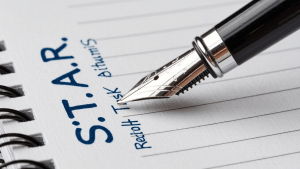
To fix this, successful candidates use the STAR Method. This is the industry standard for behavioral interview questions used by companies like Google and Amazon.
-
S – Situation: Briefly set the scene. (e.g., “Our website crashed on Black Friday.”)
-
T – Task: What was your responsibility? (e.g., “I needed to restore the database.”)
-
A – Action: What specific steps did you take? (e.g., “I coordinated with the server team and wrote a patch script.”)
-
R – Result: What was the positive outcome? Use numbers! (e.g., “We were back online in 10 minutes, saving $50k in sales.”)
Structure every story this way. It keeps you concise and proves your value.
3. Mirroring: Building Instant Rapport
People hire people they like. And people like people who are like them. This is where the psychological technique of Mirroring comes in.
Pay close attention to your interviewer’s body language and speech patterns.
-
Volume and Speed: If they speak slowly and calmly, do not answer with high-energy, fast-paced chatter. Match their tempo.
-
Posture: If they lean forward to engage, you lean forward. If they sit back and relax, you can relax your posture slightly (but keep it professional).
Don’t be a mime—keep it subtle. This creates a subconscious bond, making the interviewer feel that you “fit” the company culture perfectly.
4. The “Do You Have Any Questions?” Trap
At the end of the interview, they will always ask, “Do you have any questions for us?” Saying “No, I think we covered everything” is the fastest way to kill your chances. It shows a lack of curiosity and preparation.
To ace your job interview, you must ask questions that show you are already thinking like an employee.
-
Bad Question: “How much vacation time do I get?”
-
Good Question: “What is the biggest challenge the team is facing right now, and how could I help solve it in my first 90 days?”
This question is powerful because it visualizes you in the role helping them. It shifts their mindset from “evaluating a candidate” to “planning with a colleague.”

5. Power Posing Before You Enter
Your body language shapes who you are. Social psychologist Amy Cuddy’s research suggests that standing in a “Power Pose” (like Wonder Woman or Superman—hands on hips, chest out) for two minutes can lower cortisol (stress) and raise testosterone (confidence).
Do not do this in the interview room! Go to the bathroom or a private hallway before the interview. Stand big. Stretch your arms out. This physiological hack tricks your brain into feeling confident, even if you are terrified inside.
6. The “Weakness” Pivot
“What is your greatest weakness?” This question is a trap. If you say “I work too hard” (a humblebrag), they know you are lying. If you say “I’m always late,” you won’t get hired.
The trick to ace your job interview here is the Pivot.
-
State a real, minor weakness (not a character flaw).
-
Immediately explain how you are working to fix it.
Example: “I used to struggle with public speaking. However, I recently joined a Toastmasters club to improve, and I’ve led three team presentations in the last month.” This shows self-awareness and a growth mindset, which are top traits employers look for on LinkedIn.
Frequently Asked Questions (FAQs)
Q: How do I handle employment gaps? A: Be honest but brief. Focus on what you learned during that time. Did you take a course? Volunteer? Freelance? Frame the gap as a period of upskilling or intentional growth rather than just “unemployment.”
Q: What should I wear to a Zoom interview? A: Dress fully from head to toe. You might think wearing pajama pants is fine, but dressing professionally puts you in the right psychological “work mode.” Also, ensure your background is clean and your lighting is in front of you, not behind you.
Q: How do I negotiate salary during the interview? A: Generally, try to defer salary talks until after they offer you the job. If they push for a number early on, give a range based on market research (e.g., from Glassdoor) rather than a specific number. Say, “I’m looking for a range between $50k and $60k, depending on the full benefits package.”
Q: Is it okay to bring notes? A: Yes! Bringing a notebook with prepared questions and key points about the company shows you are organized and serious. Just don’t read from it like a script.
Conclusion
An interview is not a test of your worth as a human being; it is a skill you can practice. By mastering your first impression, using the STAR method to structure your stories, and asking killer questions, you can walk into any room (or Zoom call) with confidence. Prepare your stories, strike a power pose, and go ace your job interview. You’ve got this.