Introduction
Understanding the psychology of selling is the difference between begging for a sale and having customers beg you to take their money. I used to be a terrible salesperson. My first job out of college was selling advertising space over the phone. I would call up business owners, read a robotic script about our “features and benefits,” and get hung up on within 30 seconds. I thought the product was the problem. Or maybe the price was too high.
But then I watched a colleague—let’s call him Mike—who had the exact same script and list of leads. Mike was crushing it. He wasn’t talking about features; he was telling stories. He wasn’t pushing; he was pulling.
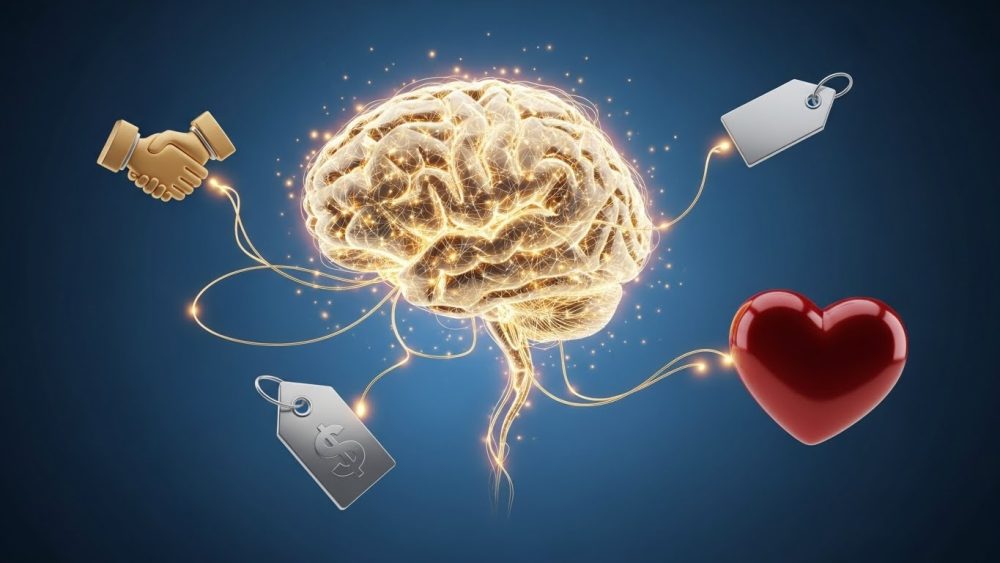
I realized then that sales isn’t about logic; it’s about emotion. People buy with their hearts and justify it with their brains. If you don’t understand how the human brain makes decisions, you are flying blind.
In this deep-dive guide, I will break down the 6 universal principles of persuasion (based on the work of Dr. Robert Cialdini) and show you how to ethically apply the psychology of selling to grow your business, increase conversions, and understand why people buy.
1. Reciprocity: The Power of the “Free Gift”
The principle of Reciprocity is simple: If I do something for you, you feel a deep, biological urge to do something for me. This is hardwired into our DNA to keep society functioning.
In business, this translates to “Give before you take.” A famous study cited by Harvard Law School showed that when waiters gave diners a single mint with their bill, tips increased by 3%. If they gave two mints? Tips skyrocketed by 14%.
How to apply this: Don’t ask for a sale immediately. Offer value first.
-
Content Marketing: Write a helpful blog post (like this one) before asking for an email address.
-
Free Samples: If you sell software, offer a 14-day free trial with no credit card required.
-
The “Unexpected Extra”: If you ship a physical product, include a handwritten note or a sticker. That tiny gesture creates a debt of gratitude in the customer’s mind.

2. Scarcity: The Fear of Missing Out (FOMO)
Humans are terrified of loss. In evolutionary terms, losing food meant death, while gaining food just meant you were full for a day. Therefore, the pain of losing is twice as powerful as the pleasure of gaining. This is known as Loss Aversion.
Scarcity hacks this fear. When something is rare, we want it more. Booking.com is the master of this. When you look at a hotel, you see bright red text: “Only 1 room left on our site!” or “15 people are looking at this right now.” Suddenly, you aren’t evaluating if the hotel is nice; you are panicking that you might lose it.
Ethical Warning: Fake scarcity destroys trust. If you say a sale ends in 24 hours, it must actually end. If customers come back a week later and the timer has reset, you have lost them forever. True scarcity (limited seats, limited stock) is a powerful driver in the psychology of selling.

3. Authority: The “Doctor” Effect
We are trained from birth to obey authority figures: parents, teachers, police officers, and doctors. If someone looks like an expert, we trust their recommendation without thinking too hard.
This is why toothpaste commercials always feature someone in a white lab coat. They might be an actor, but the symbol of authority (the coat) works. According to Robert Cialdini’s research, demonstrating expertise before attempting to influence is crucial.
How to build Authority:
-
Titles and Credentials: Display your awards or certifications prominently.
-
High-Quality Content: Teach people. If you teach me something new, I subconsciously label you as the “teacher” (authority) and myself as the “student.”
-
Confidence: Speak clearly and without hesitation. Uncertainty kills sales.
4. Social Proof: The Herd Mentality
Imagine you are walking down the street looking for a place to eat. You see two restaurants. One is completely empty. The other has a line out the door. Which one is better? You assume the full one is better, even though you haven’t tasted the food. This is Social Proof. When we are uncertain, we look to others to guide our behavior.
According to Nielsen, 92% of consumers trust recommendations from friends and family above all other forms of advertising. Actionable Tips:
-
Never launch a product page without testimonials.
-
Use “Wisdom of the Crowd” numbers (e.g., “Join 10,000+ happy customers”).
-
Show user-generated content (photos of real people using your product).

5. Liking: We Buy From Friends
This sounds obvious, but it is often ignored. We prefer to say “yes” to requests from people we know and like. But how do you make a stranger like you in 5 minutes?
-
Physical Attractiveness: (Ideally, have a clean, professional website design).
-
Similarity: We like people who are like us. If a prospect mentions they love dogs, and you mention your Golden Retriever, a bond is formed.
-
Compliments: Genuine compliments disarm people.
In the digital world, “Liking” is achieved through an “About Us” page that shows the real humans behind the brand. Show your face. Tell your story. Be relatable, not corporate.
6. Consistency: The “Foot-in-the-Door” Technique
People have a deep desire to be consistent with what they have previously said or done. If I can get you to make a small commitment (a micro-yes), you are much more likely to agree to a larger commitment later to stay consistent with your self-image.
This is called the Foot-in-the-Door technique.
-
Step 1: Ask for something small (e.g., “Sign up for our free newsletter”).
-
Step 2: deliver value.
-
Step 3: Ask for the sale.
Because the customer has already said “yes” to you once (by giving their email), they now identify as a “subscriber.” It is much easier to turn a subscriber into a customer than a cold stranger into a customer.
Frequently Asked Questions (FAQs)
Q: Is using psychology in sales manipulative? A: It depends on your intent. If you use these triggers to sell a bad product that hurts people, that is manipulation. If you use them to help people make a decision that benefits them (selling a solution to their problem), that is ethical persuasion. The tool is neutral; the user is not.
Q: Which trigger is the most powerful? A: Social Proof is often the strongest for B2C (Business to Consumer) products. We are social animals. If everyone else has it, we want it too.
Q: Does this work for B2B (Business to Business)? A: Absolutely. Business buyers are still humans. They still fear loss (Scarcity), respect experts (Authority), and follow industry trends (Social Proof). The logic might be more complex, but the emotional triggers are the same.
Conclusion
Sales isn’t a dark art; it is a human interaction. By understanding the psychology of selling, you stop fighting against human nature and start working with it. Review your website or sales script today. Are you offering value first? Are you showing social proof? Are you highlighting what they stand to lose? Tweak these elements, and watch your conversion rates climb.