

Introduction
Learning how to recover from burnout is not just about taking a vacation; it is about fundamentally rewiring how you interact with work. I remember hitting my wall three years ago. I was “productive” on paper. I was hitting deadlines, answering emails instantly, and managing three projects at once. Then, one Tuesday morning, I sat down at my laptop and just stared at the screen. I couldn’t type. I felt empty, cynical, and exhausted down to my bones.
I wasn’t just tired; I was burnt out.
Burnout is not a badge of honor. It is a state of emotional, physical, and mental exhaustion caused by excessive and prolonged stress. In 2019, the World Health Organization (WHO) officially classified burnout as an “occupational phenomenon.” It is real, and it is dangerous.
In this deep-dive guide, I will share the neuroscience of stress, explain why “just relaxing” often fails, and provide you with 7 actionable, science-backed steps on how to recover from burnout and return to your life with renewed energy.
1. Acknowledge the Beast: Stress vs. Burnout
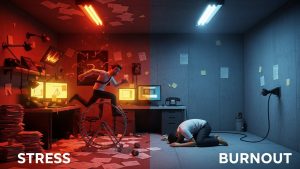
The first step is diagnosis. Many people confuse stress with burnout, but they are different.
-
Stress: You feel “too much.” Too many pressures, too much demand. You feel anxious, but you believe that if you can just get everything under control, you will feel better.
-
Burnout: You feel “not enough.” You feel empty, devoid of motivation, and beyond caring. You don’t see any hope of positive change.
To recover from burnout, you must stop trying to “push through.” Pushing through burnout is like driving a car with a flat tire. You won’t get to your destination faster; you will destroy the rim. You need to stop the car.
2. The “Do Nothing” Phase (Active Recovery)
When we try to rest, we often do it wrong. We lie on the couch and scroll through TikTok or check the news. This is not rest; this is numbing. Your brain is still processing thousands of data points per minute.
True recovery requires Non-Sleep Deep Rest (NSDR) or simply doing nothing.
-
The Protocol: Spend 10-20 minutes a day staring at the ceiling, listening to white noise, or sitting in nature without a phone. This allows your Default Mode Network (DMN) in the brain to activate, which is responsible for processing emotions and consolidating memories. If you want to know how to recover from burnout, start by boring your brain.
3. Reconnect with Your Body (The Vagus Nerve)
Burnout lives in the body. Chronic stress keeps your nervous system in a “Fight or Flight” state (Sympathetic state), flooding you with cortisol. You need to manually switch your body back to “Rest and Digest” (Parasympathetic state).
You can do this by stimulating the Vagus Nerve.
-
Box Breathing: Inhale for 4 seconds, hold for 4, exhale for 4, hold for 4. This signals safety to your brain.
-
Cold Exposure: Splashing cold water on your face triggers the “Mammalian Dive Reflex,” which instantly lowers your heart rate.
-
Humming or Singing: The vibrations stimulate the Vagus nerve in your vocal cords.

4. Set “Hard” Boundaries (The Power of No)
Burnout often comes from a lack of boundaries. You say “yes” to everything because you want to be helpful or you fear missing out. To recover, you must become a guardian of your energy.
-
Digital Boundaries: Turn off notifications after 6 PM. (See our Digital Detox Guide).
-
Work Boundaries: Do not check email on weekends. If you are always available, you are never off.
-
Emotional Boundaries: Stop trying to fix everyone else’s problems.
Saying “No” feels uncomfortable at first, but it is the only way to create the space needed to recover from burnout.
5. Rediscover “Play” Without Purpose
In our productivity-obsessed culture, we only do things if they have a “result.” We run to get fit. We read to get smart. We cook to eat. Burnout kills joy. To bring it back, you need to do something useless.
-
Paint a bad picture.
-
Build a Lego set.
-
Throw a ball for your dog.
Psychiatrist Stuart Brown, founder of the National Institute for Play, argues that play is as essential to human health as sleep. It lights up the brain’s reward centers without the pressure of “performance.”

6. Audit Your “Energy Vampires”
Take a piece of paper. Draw a line down the middle.
-
Left Side: What gives me energy? (e.g., Walking, coffee with a friend, writing).
-
Right Side: What drains my energy? (e.g., That one toxic coworker, commuting, Twitter).
Your goal is to ruthlessly eliminate or minimize the list on the right. If a specific person drains you, limit your exposure to them. If the news drains you, block the website. You have limited energy right now; stop leaking it.
7. Seek Professional Support
Sometimes, burnout overlaps with clinical depression. If you feel hopeless, unable to function, or physically ill, self-help articles are not enough. Therapy, specifically Cognitive Behavioral Therapy (CBT), can help you identify the thought patterns (“I must be perfect,” “I am not enough”) that led to burnout in the first place. There is no shame in asking for help; it is the bravest thing you can do to recover from burnout.
Frequently Asked Questions (FAQs)
Q: How long does it take to recover from burnout? A: It varies. For mild burnout, it might take a few weeks of rest. For severe burnout, it can take months or even a year. According to the Mayo Clinic, recovery is a slow process, not a switch you flip. Be patient with yourself.
Q: Can I recover from burnout while still working? A: It is difficult but possible. You need to have a serious conversation with your manager about workload, take some time off (even a long weekend), and strictly enforce the boundaries mentioned in Step 4.
Q: Is burnout just for people who hate their jobs? A: No. You can burn out from a job you love. “Passion burnout” is common among entrepreneurs and creatives because they have no separation between their identity and their work.
Q: What supplements help with burnout? A: While no pill cures burnout, adaptogens like Ashwagandha or Rhodiola may help the body manage stress. However, always consult a doctor before starting supplements.
Conclusion
Recovering from burnout is not about “fixing” yourself so you can go back to working 80 hours a week. It is about building a life you don’t need to escape from. By reconnecting with your body, setting boundaries, and embracing rest, you will not only recover from burnout, but you will also return stronger, wiser, and more resilient than before.