

Introduction
If you want to master the Eisenhower Matrix, you first have to understand the dangerous difference between “being busy” and “being productive.” I used to wear my busyness like a badge of honor. My calendar was full, my inbox was always open, and I was constantly putting out fires. I would end the day exhausted, yet I had a nagging feeling that I hadn’t actually accomplished anything significant. I was running on a hamster wheel—moving fast, but going nowhere.
This is a common phenomenon in the modern workplace. We are addicted to urgency. We prioritize the loud, vibrating notification on our phone over the quiet, long-term project that could actually change our career. We treat every email like an emergency.
Then I discovered a decision-making framework used by a World War II General and US President. It didn’t teach me how to work faster; it taught me how to ignore things that don’t matter. Since adopting this system, I haven’t just cleared my to-do list; I’ve cleared my mind.
In this comprehensive 1200-word guide, I will deconstruct the Eisenhower Matrix, explain the psychology behind the “Mere Urgency Effect,” and show you exactly how to ruthlessly prioritize your life so you can focus on what truly matters.
1. The Origin: A General’s Strategy for Peace
The Eisenhower Matrix is named after Dwight D. Eisenhower, the 34th President of the United States and Supreme Commander of the Allied Forces in WWII. He famously said, “I have two kinds of problems, the urgent and the important. The urgent are not important, and the important are never urgent.”
Later, productivity guru Stephen Covey popularized this concept in his book The 7 Habits of Highly Effective People. He organized tasks into four distinct quadrants based on two axes: Importance and Urgency.
-
Important: Tasks that contribute to your long-term mission, values, and goals.
-
Urgent: Tasks that require immediate attention (often someone else’s goals).
Most of us spend our lives trapped in the “Urgent” category, reacting to life rather than designing it. To escape, you must understand the four quadrants.
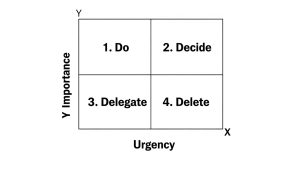
2. Quadrant 1: The “Do First” Sector (Urgent & Important)
This is the “Crisis” mode. These tasks are both urgent and important. If you don’t do them immediately, there will be serious consequences.
-
Examples: A crying baby, a server crash, a tax deadline tomorrow, a client threatening to leave.
You cannot avoid Q1 entirely. Life happens. However, many people live permanently in Q1. They are “firefighters,” constantly jumping from one crisis to the next. This leads to massive stress and inevitable burnout (which we discussed in our Burnout Recovery Guide). The goal of the Eisenhower Matrix isn’t just to manage Q1, but to shrink it by planning better.
3. Quadrant 2: The “Decide” Sector (Not Urgent & Important)
This is the “Zone of Quality.” These tasks are critical for your long-term success but—and this is the key—they do not have a screaming deadline.
-
Examples: Exercise, strategic planning, relationship building, learning a new skill, writing a book.
Because they aren’t urgent, we procrastinate on them. We say, “I’ll go to the gym tomorrow” or “I’ll start that project next week.” But “tomorrow” never comes. The Secret: Highly effective people spend 80% of their time in Q2. They prevent fires (Q1) by doing maintenance (Q2). To master the Eisenhower Matrix, you must schedule time for Q2 tasks and treat those appointments as sacred.

4. Quadrant 3: The “Delegate” Sector (Urgent & Not Important)
This is the “Zone of Deception.” These tasks feel important because they are urgent, but they actually don’t contribute to your long-term goals.
-
Examples: Most emails, random phone calls, some meetings, interruptions from coworkers asking “Do you have a minute?”
This is where the “Mere Urgency Effect” kicks in. A study published in the Journal of Consumer Research found that people consistently choose tasks with short deadlines over tasks with larger long-term payoffs, simply because the deadline creates a false sense of priority. We are wired to clear the notification badge.
The Fix: Delegate these if possible. If you can’t delegate (because you don’t have a team), you must minimize them. Batch your emails. Say “no” to meetings without agendas. Realize that other people’s urgency is not your emergency.
5. Quadrant 4: The “Delete” Sector (Not Urgent & Not Important)
This is the “Zone of Waste.” These activities offer no value and have no deadline.
-
Examples: Doomscrolling social media, watching TV shows you don’t even like, sorting spam email manually.
We often retreat to Q4 when we are tired from spending too much time in Q1. It is escapism. To apply the Eisenhower Matrix, you must ruthlessly delete these activities. If you are watching TV to relax, that’s fine (that’s Q2 recovery). But if you are watching TV to avoid work, that’s Q4 waste. Be honest about the difference.

6. The “Mere Urgency Effect”: Why Your Brain Lies to You
Why is this so hard? Our brains are evolutionarily designed to prioritize immediate threats (a tiger in the bushes) over long-term threats (heart disease in 20 years). In the modern world, a Slack notification mimics the “tiger.” It triggers a dopamine loop.
The Mere Urgency Effect explains why we will spend an hour replying to unimportant emails (Q3) while neglecting to write a business proposal (Q2) that could double our income. The emails offer immediate closure. The proposal offers delayed gratification. The Eisenhower Matrix is a cognitive tool to override this biological glitch. It forces you to pause and ask, “Is this actually important, or is it just loud?”
7. How to Implement This Daily (A Practical Workflow)
You don’t need fancy software. A piece of paper works best.
-
The Brain Dump: Write down everything you have to do today.
-
The 4 Boxes: Draw the matrix.
-
The Sort: Place every task into a box. Be strict. Only 3 items allowed in Q1.
-
Execute:
-
Do Q1 immediately.
-
Schedule Q2 for specific time blocks (see our Time Blocking Guide).
-
Delegate or Batch Q3 for the afternoon slump.
-
Cross out Q4.
-

Frequently Asked Questions (FAQs)
Q: What if everything feels like Quadrant 1? A: If everything is urgent and important, you are overcommitted. You need to say “no” more often. Re-evaluate your projects. Are they really all fires, or are you just procrastinating until the deadline makes them fires?
Q: Can I use apps for this? A: Yes. Apps like Todoist allow you to use labels (P1, P2, P3, P4) which correspond perfectly to the matrix. Notion also has excellent templates for Eisenhower Matrices.
Q: How do I handle a boss who constantly gives me Q3 tasks? A: This is tricky. Communication is key. Show them your matrix. Say, “I have these Q1 and Q2 projects that drive revenue. If I do this new Q3 task, the Q1 task will be delayed. Which one would you like me to prioritize?” Make them choose.
Q: Is Q2 always work-related? A: No! Q2 includes your health, your family, and your hobbies. Going for a run is a Q2 activity (Important, Not Urgent). If you ignore it long enough, it becomes a Q1 crisis (Health Emergency).
Conclusion
The Eisenhower Matrix is more than a productivity hack; it is a philosophy of life. It challenges you to stop being a slave to the urgent and start becoming the architect of the important. By constantly asking, “Is this getting me closer to my goals?” you reclaim your time from the noise of the world. Start drawing your boxes today. The fires will always be there, but your dreams won’t wait forever.