

Introduction
Understanding the battle of emotional intelligence vs IQ is the key to unlocking why the “smartest” people in the room aren’t always the most successful. We all know that one person from high school or college: they had a 4.0 GPA, aced every exam, and seemed destined to run the world. Yet, ten years later, they are stuck in a mid-level job, frustrated and stagnant. Meanwhile, the student who got average grades but knew how to talk to people is now the CEO.
Why does this happen? For decades, our education system told us that IQ (Intelligence Quotient) was the single predictor of future success. We were wrong.
I used to believe that raw brainpower was everything. I spent years sharpening my technical skills, ignoring my “soft skills.” It wasn’t until I managed a team and failed miserably that I realized technical skills get you hired, but people skills get you promoted.
In this deep-dive guide, I will deconstruct the science behind Emotional Intelligence (EQ), compare emotional intelligence vs IQ, and show you actionable ways to train your EQ to become a better leader, partner, and learner.
1. Defining the Players: What is EQ?
Before we compare them, we must define them.
-
IQ (Intelligence Quotient): Measures your ability to learn, understand, and apply information. It covers logical reasoning, word comprehension, and math skills. It is largely fixed at birth.
-
EQ (Emotional Intelligence): Measures your ability to recognize, understand, and manage your own emotions and the emotions of others.
The term was popularized by psychologist Daniel Goleman in his groundbreaking 1995 book. He argued that EQ consists of four pillars:
-
Self-Awareness: Knowing what you feel and why.
-
Self-Management: Handling your distressing emotions effectively.
-
Social Awareness: Empathy and understanding others.
-
Relationship Management: Influencing and inspiring others.
Unlike IQ, which is static, EQ is a flexible skill set that can be learned and improved at any age.

2. The Science: Why EQ Predicts Success
When we look at the data regarding emotional intelligence vs IQ, the results are startling. Research conducted by the Carnegie Institute of Technology found that 85% of your financial success is due to skills in “human engineering” (personality, ability to communicate, negotiate, and lead). Only 15% is due to technical knowledge.
Think about it. In the modern workplace, almost everyone is “smart enough.” The barrier to entry for a doctor, engineer, or programmer ensures a baseline IQ. Once you are in the door, IQ loses its predictive power. The differentiator becomes how you handle pressure, how you resolve conflict, and how you collaborate.
If you yell at your team when you are stressed, your high IQ doesn’t matter. You are a liability. High EQ individuals create psychological safety, which Google found to be the #1 factor in high-performing teams.
3. The “Amygdala Hijack”: Self-Management in Action
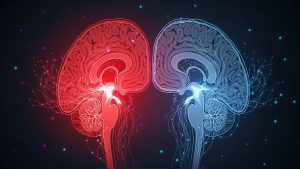
Have you ever sent an angry email and regretted it 10 minutes later? That is called an Amygdala Hijack. Your brain has two key players here:
-
The Amygdala: The ancient emotional processor (Fight or Flight).
-
The Prefrontal Cortex: The logical thinker.
When you are triggered, the Amygdala takes over before the logic center can process the information. People with low EQ let the hijack happen. They explode. People with high EQ practice the “6-Second Pause.” Chemicals released during an emotional spike typically last about 6 seconds. If you can breathe and wait for 6 seconds, you allow your Prefrontal Cortex to come back online. This simple biological hack is the difference between a ruined reputation and a moment of composure.
4. Empathy: The Superpower of Connection
In the debate of emotional intelligence vs IQ, empathy is the ace card. Empathy isn’t just “being nice.” It is data collection. Cognitive Empathy allows you to understand someone’s perspective (“I see why you think that”). Emotional Empathy allows you to feel what they feel.
In a negotiation, IQ helps you calculate the numbers. EQ helps you read the other person’s face to know if they are bluffing, frustrated, or ready to close. How to train it: Practice “Active Listening.” When someone speaks, do not plan your response. Listen to understand. Then, say: “It sounds like you are feeling frustrated because [X], is that right?” This validates the other person and disarms conflict instantly.
5. Can You Increase Your IQ? No. Can You Increase EQ? Yes.
This is the most important distinction. While you can learn new facts (increasing knowledge), your raw processing power (IQ) is largely genetic. However, EQ is a set of habits.
How to improve your EQ today:
-
Journaling: Writing down your feelings forces you to process them (Self-Awareness).
-
Ask for Feedback: Ask a trusted friend, “How do I act when I’m stressed?” The answer might hurt, but it is necessary data.
-
Observe Body Language: Start watching people’s hands and eyes in meetings. Non-verbal cues make up 55% of communication.

6. The Dark Side: Can EQ Be Used for Evil?
We must address the nuance. High EQ is a tool, like a hammer. It can build a house or break a window. Manipulators, con artists, and cult leaders often have incredibly high EQ. They know exactly how to read people and exploit their emotions. However, for the vast majority of leaders and professionals, High EQ combined with strong ethics is the ultimate leadership trait. It allows you to drive results without burning out your team.
Frequently Asked Questions (FAQs)
Q: Is EQ more important than IQ for engineers/programmers? A: Yes, eventually. To be a junior coder, you need IQ. To become a Senior Engineer, CTO, or Lead, you need EQ to mentor juniors, manage stakeholders, and navigate office politics.
Q: Can a person have high IQ and low EQ? A: Absolutely. The stereotype of the “brilliant jerk” exists for a reason. These individuals often struggle in their careers because nobody wants to work with them, despite their brilliance.
Q: How do I test my EQ? A: There are tests like the Mayer-Salovey-Caruso Emotional Intelligence Test (MSCEIT), but the best test is real life. Do you have long-lasting friendships? Do people come to you for advice? Do you handle stress well? These are better indicators than an online quiz.
Q: Does EQ increase with age? A: Generally, yes. It is called maturity. However, age doesn’t guarantee it. Some people repeat the same emotional mistakes for 50 years. It requires intentional effort.
Conclusion
The verdict on emotional intelligence vs IQ is clear: IQ gets you in the door, but EQ gets you up the ladder. In an age of AI, where computers can out-compute our IQ, our ability to connect, empathize, and lead humans becomes our most valuable asset. Stop worrying about how smart you are, and start worrying about how self-aware you are. That is the path to true success.