
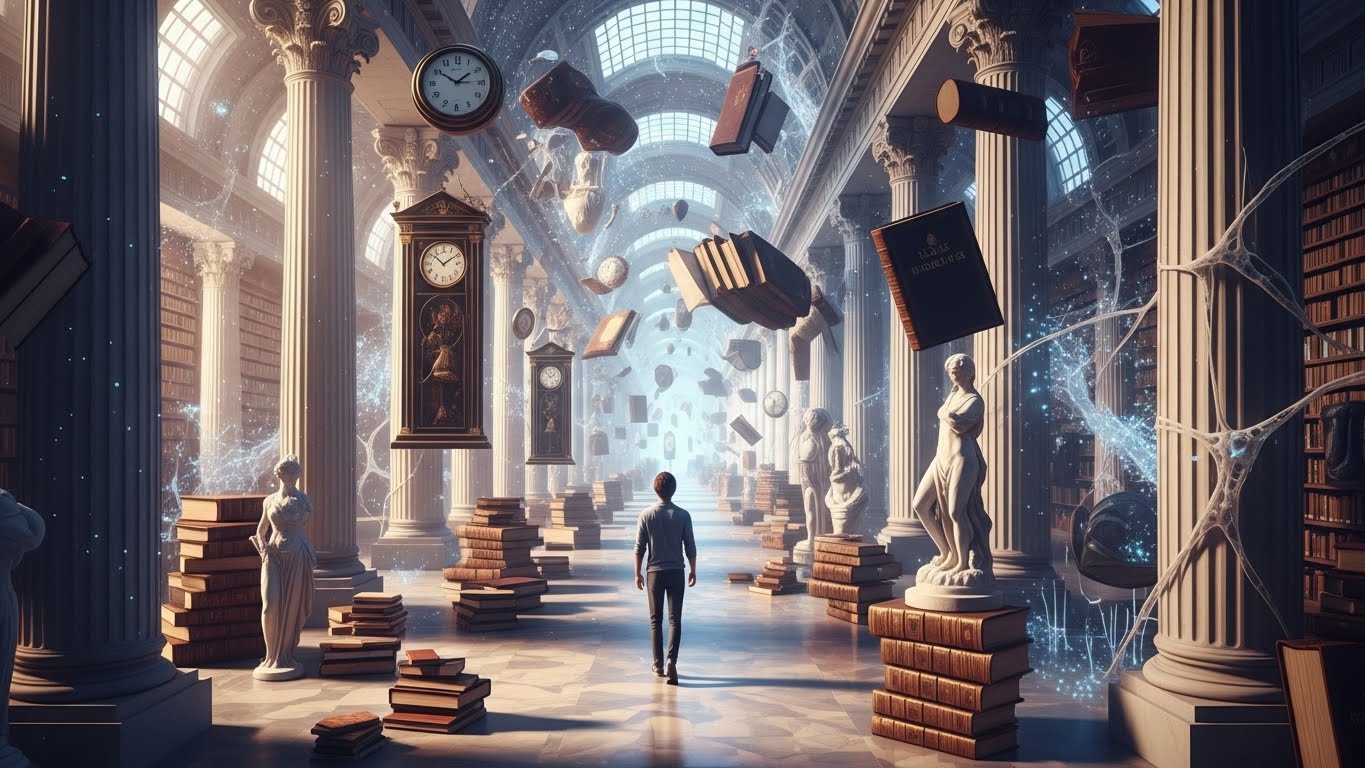
Introduction
Learning how to remember everything you read feels like a superpower in a world of information overload. I used to have a memory like a sieve. I would read a non-fiction book, feel incredibly smart while reading it, and then two weeks later, I couldn’t tell you a single specific concept from Chapter 3. I would walk into a room and forget why I entered. I forgot names the second after shaking hands. I thought I was just “bad at remembering.”
Then I watched a TED Talk by Joshua Foer, a journalist who won the U.S. Memory Championship after training for just one year. He wasn’t a savant; he was a normal guy who learned a specific technique. That technique is the Memory Palace (or the Method of Loci).
It sounds like fiction—something Sherlock Holmes does to solve crimes. But it is actually a 2,500-year-old method used by Greek orators to memorize hours of speeches without notes. The secret isn’t about being smart; it’s about translating boring facts into crazy, vivid images and placing them in a mental location you already know.
In this comprehensive 1200-word deep dive, I will explain the neuroscience behind spatial memory, walk you through building your first “palace,” and show you exactly how to remember everything you read by hacking your brain’s natural GPS system.
1. The Ancient Origin: The Tragedy of Simonides
To understand why this works, we have to go back to ancient Greece. The legend goes that a poet named Simonides of Ceos was attending a banquet. He stepped outside for a moment, and the roof of the banquet hall collapsed, crushing everyone inside beyond recognition.
Simonides was able to identify every single body for the grieving families. How? He realized he could close his eyes and visualize exactly where everyone had been sitting around the table. He used his Spatial Memory.
This discovery led to the Method of Loci (Loci being Latin for “places”). The Greeks realized that humans are terrible at remembering abstract data (numbers, lists, words) but incredible at remembering locations. You might forget your wife’s phone number, but you can probably walk through your childhood home in your mind and touch every piece of furniture in the dark. That spatial map is hardwired into your hippocampus.

2. The Neuroscience: Why “Boring” is Forgettable
Why do we forget? Because our brains are efficiency machines. They delete information that seems irrelevant or mundane to save energy. This is why you forget what you had for lunch last Tuesday, but you remember the time you saw a car crash ten years ago. Emotion and novelty signal importance.
The Baker/Baker Paradox, cited by researchers like neuroscientist David Eagleman, illustrates this perfectly.
-
If I tell you a man’s name is Mr. Baker, you will likely forget it. The name is abstract sound.
-
If I tell you a man is a baker (profession), you will likely remember it. Why? Because you instantly visualize a white hat, the smell of bread, and flour on an apron.
To master how to remember everything you read, you must convert abstract information (Mr. Baker) into concrete, visual, and preferably weird images (a man wearing a bread hat). The Memory Palace technique forces this conversion.
3. Step-by-Step: Building Your First Palace
Let’s build one right now. We are going to memorize a random list: Apples, Milk, Batteries, Soap, and a Dentist Appointment.
Step 1: Choose Your Palace Pick a place you know perfectly. Your current house is the best starter palace.
Step 2: Define the Route Visualize walking through your front door. What is the first thing you see? Maybe the coat rack. Then you walk into the living room (the couch). Then the kitchen (the fridge). Define 5 distinct “stations” or stopping points along this path.
Step 3: Encode the Images (The Crazier, The Better) Now, place the items on the stations. But don’t just put “apples” on the coat rack. That’s boring.
-
Station 1 (Coat Rack): Imagine a giant, rotting Apple putting on a coat. It smells terrible. Flies are buzzing.
-
Station 2 (Couch): Imagine a massive cow sitting on your couch, being milked by a robot. The Milk is spraying everywhere.
-
Station 3 (TV): Imagine the TV remote is powered by giant, sparking car Batteries that are shocking your hand.
-
Station 4 (Kitchen Sink): Imagine you are washing your hands, but the Soap is actually a live frog slipping out of your fingers.
-
Station 5 (Fridge): You open the fridge, and your Dentist is sitting inside, drilling a tooth made of ice.

Step 4: The Walkthrough Close your eyes. Walk through your front door. Look at the coat rack. What do you see? The rotting apple. Look at the couch. The cow. You will find it is almost impossible not to remember these items. You have hooked the data onto your brain’s spatial grid.
4. Advanced Application: Memorizing a Speech or Book
Okay, a grocery list is easy. But what about a book? The process is the same, but you need a bigger palace.
-
Chapter 1: The Front Porch.
-
Chapter 2: The Foyer.
-
Chapter 3: The Kitchen.
Convert the main idea of the chapter into a symbol. If Chapter 1 is about “The decline of the Roman Empire,” visualize Julius Caesar crying on your front porch. If you run out of space in your house, use your school, your office, or even a level from your favorite video game. Yes, maps from Call of Duty or Minecraft work exceptionally well because your brain navigates them spatially just like the real world.
5. The “Dual Coding” Theory
This technique leverages Dual Coding Theory, proposed by Allan Paivio. This theory suggests that we remember information better when it is encoded in two ways: Verbal and Visual.
When you read a book, you are using only the verbal channel. When you create a Memory Palace, you are using the verbal channel (the concept) AND the visual channel (the crazy image) AND the spatial channel (the location). You are creating three separate neural pathways to the same piece of information. This triangulation makes the memory sticky.

6. Maintenance: Spaced Repetition
A Memory Palace isn’t magic; the images will fade if you don’t visit them. You need to “walk through” your palace occasionally.
-
Day 1: Create the palace.
-
Day 2: Walk through it once mentally.
-
Day 7: Walk through it again.
This combines the Memory Palace with Spaced Repetition (which we discussed in our Language Learning Guide). If you do this, the information becomes permanent knowledge.
Frequently Asked Questions (FAQs)
Q: Will I run out of space in my head? A: No. Your capacity for spatial memory is practically infinite. You can reuse the same palace for different lists (just “clean” it out mentally first), or you can create new palaces. Memory champions have hundreds of palaces (their grandma’s house, their commute route, etc.).
Q: Is this only for visual learners? A: No. Everyone has spatial memory. Even if you think you can’t visualize well, you know where your bathroom is in the dark. You know where the milk is in your local grocery store. That knowledge is enough to anchor memories.
Q: Can I use this for abstract concepts like philosophy? A: Yes, but it requires more creativity. You have to turn the abstract into the concrete. For “Justice,” visualize a Judge’s gavel or Batman. For “Freedom,” visualize a bird flying out of a cage. The symbol doesn’t have to be logical; it just has to remind you of the concept.
Q: How long does it take to get good at this? A: You can see results in your first attempt (try the grocery list above). To become fluent enough to memorize a deck of cards or a speech in real-time, it takes a few weeks of daily practice (15 minutes a day).
Conclusion
Memory is not a fixed trait like eye color; it is a muscle you can build. We rely so heavily on our phones to remember things for us that our mental muscles have atrophied. By using the Memory Palace technique, you aren’t just learning a party trick; you are reclaiming your mind’s potential. Start small. Pick five items. Put them in your living room. You will be shocked at how easy it is to learn how to remember everything you read.