

Introduction
Designing the perfect morning routine is not about waking up at 4:00 AM to take an ice bath just because a billionaire on YouTube told you to. I used to think that to be productive, I had to suffer. I would set my alarm for an ungodly hour, drag myself out of bed, and try to force a two-hour workout before sunrise. By 10:00 AM, I was exhausted, grumpy, and chugging my third coffee.
It turns out, I was doing it all wrong. A morning routine shouldn’t deplete your willpower; it should generate momentum.
The way you start your morning sets the trajectory for the entire day. If you start with chaos, scrolling through emails and reacting to other people’s demands, you spend the rest of the day playing catch-up. But if you start with intention, you win the day before it even begins.
In this deep-dive guide, I will share the neuroscience behind waking up, explain why checking your phone first thing is destroying your focus, and show you how to build the perfect morning routine that fits your actual life, not an Instagram influencer’s fantasy.
1. The Science of Light: Resetting Your Circadian Rhythm
Most people think the first step of a morning routine is coffee. According to neuroscientists like Dr. Andrew Huberman, the first step should actually be light.
Your body runs on a 24-hour internal clock called the Circadian Rhythm. This clock dictates your energy levels, your hunger, and your sleep quality. The primary trigger that resets this clock is sunlight entering your eyes.
When you view bright light within 30 to 60 minutes of waking up, it triggers a spike in cortisol (the good kind, for alertness) and sets a timer for melatonin (the sleep hormone) to be released about 12-14 hours later.
My Routine: I step outside onto my balcony for 10 minutes immediately after waking up. No sunglasses, just natural light. This single habit cured my insomnia and eliminated my morning brain fog. If you want the perfect morning routine, you must prioritize light over caffeine.

2. Hydration First, Caffeine Second
We lose about a liter of water every night simply by breathing and sweating. When you wake up, you are essentially a dehydrated sponge.
If you drink coffee immediately, you are putting a diuretic (something that makes you pee) into a dehydrated system. This leads to the dreaded “afternoon crash” later in the day.
The Protocol:
-
Drink 16oz (500ml) of water immediately. Ideally with a pinch of sea salt for electrolytes.
-
Wait 90 minutes before drinking coffee.
Why wait? Adenosine is the molecule that makes you feel tired. Caffeine blocks adenosine receptors. If you drink coffee too early, you don’t clear the adenosine naturally; you just mask it. Once the caffeine wears off, the crash hits hard. Waiting 90 minutes allows your body to wake up naturally first.
3. The “No Phone” Rule: Protect Your Dopamine
This is the hardest but most important rule. Do not touch your phone for the first 30 minutes.
When you wake up, your brain is transitioning from Delta waves (sleep) to Theta and Alpha waves (relaxed, creative states). This is a prime state for creative thinking and calmness.
If you immediately open TikTok, Instagram, or Email, you flood your brain with cheap dopamine and cortisol. You instantly switch into “Reactive Mode.” You are letting the world dictate your mood before you have even brushed your teeth.
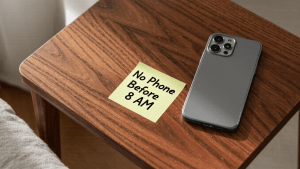
I charge my phone in the kitchen overnight. This physical separation is the only way I can stick to the perfect morning routine. If it’s on my nightstand, I will check it.
4. Movement: Generate Energy, Don’t Wait for It
Newton’s First Law of Motion applies to humans too: A body at rest tends to stay at rest. You will not “feel” like working out in the morning. Motivation follows action, not the other way around.
You don’t need to run a marathon. You just need to get your heart rate up and blood flowing to your brain.
-
5 minutes of stretching.
-
20 jumping jacks.
-
A brisk walk around the block.
According to the Mayo Clinic, morning exercise improves focus and cognitive function for hours afterward. It is a biological investment that pays dividends all day.
5. Mindfulness or Journaling: Clear the Mental Cache
Once the body is awake, you need to wake up the mind. Many high performers swear by journaling to clear “mental clutter.”
I use a technique called “Morning Pages” (popularized by Julia Cameron). I write three pages of stream-of-consciousness thoughts. It might be complaining about the weather, worrying about a deadline, or planning dinner. Getting these thoughts out of your head and onto paper prevents anxiety from looping in the background of your mind.
If writing isn’t your thing, try 5 minutes of meditation. Apps like Headspace or Calm make this easy. This practice thickens the prefrontal cortex, the part of the brain responsible for focus and discipline.

6. Eat the Frog (Deep Work Block)
The final step of the perfect morning routine is transitioning into work. As we discussed in our article on Procrastination, your willpower is highest in the morning.
Use this time to “Eat the Frog”—do the hardest, most important task of the day before you check your email. If you finish your biggest task by 10:00 AM, the rest of the day feels like a victory lap.
Frequently Asked Questions (FAQs)
Q: I am a night owl. Does this apply to me? A: Yes! The specific time you wake up matters less than what you do when you wake up. Even if you wake up at 10 AM, you still need light, hydration, and a no-phone period to optimize your brain.
Q: I have kids/pets. I don’t have time for a 2-hour routine. A: A “perfect” routine doesn’t have to be long. You can do a “Power Routine”: 2 minutes of sunlight, 1 glass of water, 5 minutes of stretching. It’s about intention, not duration.
Q: What if I miss a day? A: Don’t let a bad morning turn into a bad day. If you sleep in and miss your routine, just drink some water and start working. Consistency over perfection is key.
Q: Should I eat breakfast immediately? A: This depends on your body. Some people thrive on intermittent fasting (skipping breakfast), while others need fuel. Listen to your body, but try to avoid high-sugar cereals that cause an energy crash later.
Conclusion
The perfect morning routine isn’t about impressing people on social media; it is about protecting your energy. By prioritizing light, hydration, movement, and mental clarity, you stop reacting to the world and start creating your own reality. Start small tomorrow morning: put the phone away, drink water, and step into the sunlight. Your brain will thank you.